Viral T-Shirt Designs: Why Some Make People Stop And Buy
 Time To Read 11 min.
 You scroll past thousands of designs every day. But one makes you stop. This article reveals the invisible psychology behind viral POD T-shirt designs.
Have you noticed this? You scroll through hundreds of designs without noticing most of them. And then one makes you stop. Not because it’s beautiful. Not because it’s technically perfect. But because it hits something inside you before you even have time to think. Viral t-shirt designs succeed in the print on demand space because they tap into tiny psychological triggers most people never consciously notice.
In this article, you’ll see what actually happens in those split seconds between scrolling, stopping, laughing, recognizing yourself, and finally buying. I’ll combine behavioral psychology with real-world print on demand examples and personal experience to show why some designs quietly fail while others spread on their own.
You Scroll Until One Viral T-Shirt Design Stops You
You scroll and suddenly stop because something breaks the rhythm you were just numb to. Your thumb has been moving on autopilot, past hundreds of designs that all blur together, until one image interrupts that trance. It happens because something in it feels instantly familiar, charged, or emotionally loud. I have seen this exact moment play out countless times while analyzing POD stores, ads, and even my own early test designs. One simple example that still sticks with me is a plain black shirt with nothing but white text saying Dog Hair Is My Glitter. No fancy illustration, gradients, or complex layout. Yet it consistently outperformed detailed dog portraits with far more artistic effort. People stopped because they felt exposed in a funny, truthful way.
You stop scrolling when a design mirrors a thought you have had but never articulated. I once tested two nearly identical designs in the same niche. One said Coffee First, People Later. The other showed a beautifully illustrated coffee cup with decorative typography. The text-only version received over three times the clicks. Because it sounded like an internal monologue. You recognized your own mood in it.
In my own print on demand stores, I have watched unknown stores go from zero to dozens of sales with one brutally simple design that interrupted scrolling behavior. The stop happens before logic kicks in. Your brain flags something as personally relevant, emotionally charged, or socially useful. And once that micro-pause is triggered, click, the share, the purchase suddenly becomes possible.

You Recognize Yourself In A Design
You recognize yourself in a design when it puts words, symbols, or attitudes on something you already carry inside. It feels like being understood by a stranger. I have seen this again and again with identity-driven niches. Not broad interests like fitness or travel, but very specific self-images such as introverted dog lover, burned-out nurse, sarcastic office worker, or quiet creative who hates small talk.
One example that always stuck with me came from a tiny Shopify store in the mental health niche. The best-selling shirt wasn’t visually impressive at all. It simply said, I Overthink Everything, in a clean, neutral font. People left reviews talking about how they felt called out. That’s the moment of self-recognition doing the selling. When the buyer thinks: This is so me.
If you look at your own buyer behavior, you recognize that you buy shirts to quietly communicate who you are without explaining yourself. That’s also why people share these designs with comments like Tagging you because this is literally you. Self-recognition creates instant emotional ownership. And once you feel personally reflected in a design, the decision to buy feels like claiming a piece of yourself.
You Laugh Before You Think
You laugh before you think because humor bypasses your filters. It hits first, logic comes later. In print on demand, this moment is pure gold. I have seen designs sell because they triggered a fast, involuntary grin. That tiny burst of amusement is powerful. It disarms skepticism. It creates a chemical reward in the brain before any conscious evaluation of price, quality, or usefulness even begins.
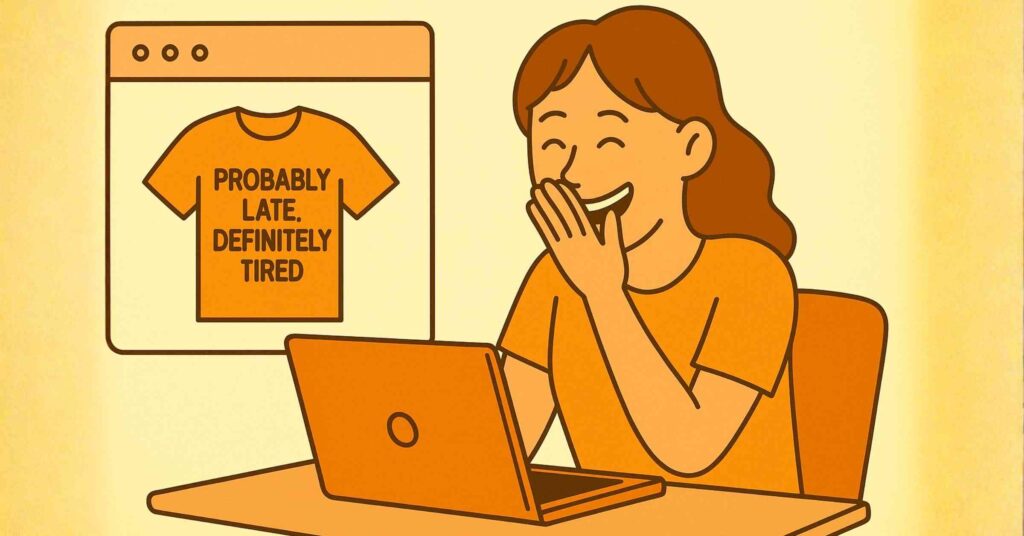
One of the strongest examples I ever tracked was a brutally simple text design that said, Probably Late, Definitely Tired. The conversion rate was noticeably higher than its niche average. People were buying because they laughed and felt called out in a harmless way. That split second of amusement made them feel safe to click.
I noticed the same effect in my own testing when comparing ironic humor versus motivational humor. A design that said, Hustle Hard, barely moved. A version that said, Still Tired, Still Trying, gained traction almost immediately. The second one worked because it removed pressure and replaced it with self-aware humor.
You laugh before you think because humor feels like permission. That’s also why sarcastic designs spread so fast in group chats and social feeds. Someone sees it, laughs, and sends it to a friend without overanalyzing it. The share happens while the emotion is still warm. And once people associate a design with a positive emotional jolt, even a small one, the path to purchase becomes far shorter than most store owners realize.

👉 Shortcut Your Way Into POD Success
Why waste weeks figuring everything out on your own when you can start with a proven blueprint? This German Shepherd POD Niche Starter Set gives you ready-to-use designs, brand name inspiration, domain name ideas, trending keywords, and even mockups that make your store look professional from day one. Take the shortcut and see what’s inside:
You Feel Pulled Toward One Viral T-Shirt Design Without Knowing Why
You feel drawn without knowing it because your brain is making decisions long before you become aware of them. This is the quiet power behind many viral POD designs. There’s no obvious joke, no loud statement, no bold declaration of identity. And yet something pulls you in. You cannot explain it, but you pause.
One case I still remember clearly was a minimalist line illustration of a sleeping cat on a beige background with a very small, calm caption underneath. Nothing about it screamed bestseller. Yet people stayed on that product page significantly longer than on others in the same niche. The design felt quiet. Soft. Safe. Buyers later described it as soothing and peaceful.
I experienced this myself while browsing late at night, tired and overstimulated. Loud colors and bold claims repelled me instantly. But a muted color palette, gentle contrast, and a centered, balanced layout made me slow down. I didn’t decide to like the design. My nervous system did it for me. That is the part most store owners underestimate. Attraction is often physiological before its rational.
You feel drawn when a design matches your internal state without demanding anything from you. These are often the designs that don’t go viral overnight but quietly generate consistent sales over months. They don’t shout. They whisper. And somehow, the right people hear them.

You Trust Simple More Than Busy
You trust simple more than busy because simplicity feels honest. When you see a design overloaded with fonts, icons, shadows, gradients, and visual effects, something in you quietly tightens. It feels like it’s trying too hard. I noticed this pattern early on while reviewing failed POD stores during consulting sessions. Many of them were packed with technically impressive designs that showed hours of effort. And yet they barely converted. Meanwhile, a single-word shirt in a clean font was selling steadily in the same niche with no visual drama at all.
One example that made this painfully clear was a pet niche store that tested two versions of the same concept. One design showed a highly detailed, full-color illustration of a dog surrounded by decorative elements and multiple text lines. The second version was just a small, centered paw print with the word Home underneath it. The simple version sold more than four times as often. When customers were later asked why they chose it, most couldn’t articulate a visual reason. They just said it felt right.
You trust simple because it feels less manipulative. It gives your eyes room to breathe. It lets your mind fill in meaning rather than being overwhelmed by information. Busy designs demand effort. Simple designs offer clarity. And when you’re scrolling fast, tired, distracted, and emotionally saturated, clarity feels like safety. In that moment, your brain rewards relief.
Viral T-Shirt Designs Make Others Follow Instinctively
You buy first and others follow because every viral product begins with one quiet, unremarkable decision. There’s just one person trusting their instinct enough to click Buy Now. The first buyer is never aware of the chain they’re starting. They simply respond to a private emotional moment that happens in front of a screen.
I once optimized a brand-new POD store that launched with almost no traffic and no social proof at all. One hoodie sold on day three. That single order triggered something subtle but powerful. The next visitor no longer saw an empty product page. They saw 1 sold. Two more orders followed within 48 hours. Then five more the following week. Nothing about the design changed. Only the visible proof that someone else had already trusted it.
You buy first and others follow because humans rarely want to feel like the very first person stepping onto thin ice. We look for subtle signals that say, You won’t be alone in this. One review or one visible purchase is often all it takes to tip hesitation into action. Virality starts with one small act of trust that makes the next one feel safer.

TL;DR: Why Some POD T-Shirt Designs Go Viral
Some t-shirt designs go viral because they interrupt your scrolling, mirror who you are, trigger emotion before logic, and feel visually effortless. You stop because you recognize yourself. You share because you laughed or felt understood. And you trust because the design feels simple and honest. And once the first buyer acts, social proof quietly takes over.
Virality in print on demand is rarely about artistic skill alone. It’s also about emotional precision, timing, and human psychology working together in tiny, invisible moments. If you want to see how this connects to real niche strategy, my guide Best Niches for Shopify Print on Demand in 2025 shows exactly where these effects appear in the market.

My personal note on viral T-shirt designs
I’m Dani, founder of Printpreneur. After a decade in print on demand, I’ve analyzed thousands of POD designs across marketplaces and Shopify stores to understand why some stop the scroll while others disappear. Viral designs work because they hit emotional triggers, timing, and clarity.
FAQ: Frequently Asked Questions
If you’re just getting started with print on demand, you’ll find more beginner questions on my main FAQ page.
Next Steps In Your POD Journey 👇
Explore handpicked articles to deepen your POD journey.
-
How To Create POD Designs With Vexels
Introduction 👉 Shortcut Your Way Into POD Success Why waste weeks figuring everything out on your own when…
-
The Best Graphic Design Tools for Print on Demand
Introduction 👉 Shortcut Your Way Into POD Success Why waste weeks figuring everything out on your own when…
-
Make Money As A College Student With Print On Demand
Introduction 👉 Shortcut Your Way Into POD Success Why waste weeks figuring everything out on your own when…